AMITY-UNESCO RESULT
Answer: (Jarawa in Andaman, Lepcha in Sikkim,Jaunsari in Uttarakhand, Kondh in Orissa,
Bodo in Assam, Khasi in Meghalaya, Gond in Madhya Pradesh, Gaddi in Himachal Pradesh,
Rabari in Gujarat, Bhil in Rajasthan)
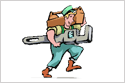
The article had no author. It had no title. It had no reason to be in the newspaper. But it knew me. Our half-yearly exams were over, festive vibes had begun, and mornings were pleasantly cold. During our library period, my friend and I were asked to find an article in a stack of newspapers from 2009 and 2010. As we flipped through the yellow, crinkly pages, an untitled article caught my eye.
Its first line read: She looked at the wall clock at 12:17 PM and knew she was late for the maths lesson. I ignored it. Next day in the corridor, I got caught up talking to someone. When I finally looked at the clock, it was 12:17 PM. I was late for my lesson. The sentence in the newspaper flashed through my mind.
Next day, I rushed to the library and found the newspaper. The line had changed. It read: She lost a black pen today. I had lost mine the previous lesson. I decided to test it.
During fourth period, I secretly drew a star beneath my desk. When I checked the newspaper, the words were printed in bold: Today, in the fourth period, she drew a star beneath her desk. Someone or something was watching me. I swiftly threw the newspaper into the classroom bin.
For three days, nothing happened. Then I entered my classroom and found it lying on my desk. Nobody knew who had put it there. This time, I went straight to the library.
I found copies from 2009, 2010, and 2012. The same article appeared in each, but the wording was different. At the bottom of the oldest copy was a handwritten sentence: Every reader eventually becomes an author. I read it twice.
Then the first line changed. ‘She is going to open the blue locker tomorrow.’ It wasn’t describing the past anymore. It was predicting my future. The next day, I deliberately avoided the locker. When I returned to the newspaper, the sentence had changed: She decided not to open the locker today. That’s when I understood. The newspaper wasn’t predicting my future. It was rewriting itself according to my choices. I turned to the last page. A blank sheet was attached to it. At the top were three words: What Happens Next? Beside it lay a pen.
Below the title was my name. And beneath my name, tomorrow’s date.
A new sentence appeared: She will pick up the pen. I stepped away. The sentence changed.
‘She decides not to.’ The newspaper was waiting for me to choose. I finally understood the rule: the reader becomes the author, and whatever the author writes becomes the next event. I picked up the pen. If I wrote that the newspaper disappeared, perhaps the nightmare would end.
But then another line appeared: The author doesn’t decide what happens but decides who it happens to. My hand began moving while more words appeared: Tomorrow, someone else will find this newspaper. I dropped the pen.
On the first page, a new name slowly appeared. Not mine. Someone else’s. And beneath it, the original sentence returned: She looked at the wall clock and knew she was late for the maths lesson. The newspaper had found its next reader. And I had chosen them.
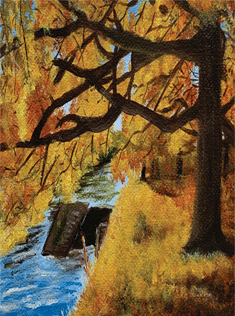
Promised land
Aadya Behl, AIS Mayur Vihar, X A
We cross our palms to pray for the celestial
While they lean to trace the raw, terrestrial
Two distant orbits that shouldn’t coincide
Yet, bound by promises, their rhythms drive
Man kneels and paints his promised land
No stroke muddies under trembling hands
He waits to cast aside this heavy clay
And finally reach for the light of day
For what is faith without a prayer to send?
And what is life without a blazing end?
While beyond the vault of falling dew
An effulgent woman slips the curtain through
She glides through starlight, temper wise
With endless silver burning in her eyes
To find the one thing heaven cannot hold
A world not frozen, incandescent, or gold
For what is peace without a storm to break?
And what is joy without the heart to ache?
She watches stardust gather on the floor
And presses palms on stones out the door
Envious of the tear running down his cheek
How his finite heart grows warm and weak
He reaches up to claim her peaceful sphere
She reaches down to steal a single year
Bound by the same eternal, restless curse
To want the half they lack in the universe
They pause together on a threshold grand
Calling the other to their Promised Land.










 View Archives