Back to roots
Alumnus-Turned-UCMS Principal On The Future Of Medical Landscape
Yunglee Shukha, XII A & Joseph Lalruatngheta, XI A, AIS Saket
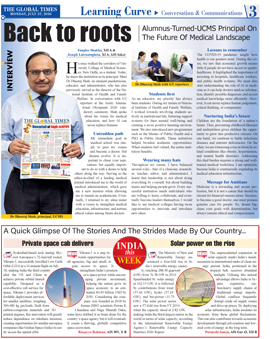
He once walked the corridors of University College of Medical Sciences, New Delhi, as a student. Today, he steers the institution as its principal. Meet Dr Dheeraj Shah, an eminent paediatrician, educator, and administrator, who has also previously served as the director of the National Institute of Health and Family Welfare. In conversation with GT reporters at the Amity International Olympiads 2026 valedictory ceremony, Shah spoke about his vision for medical education, and how AI can never replace humans.
Untrodden path
My immediate goal in medical school was simply to pass my exams and become a doctor. But dreams evolve. It is important to chase your aspirations, but equally important to do so with a desire to help others along the way. Serving as the editor-in-chief of a leading medical journal introduced me to the world of medical administration, which gave me a new mission while allowing me to remain an academician. Eventually, I returned to my alma mater with a vision to strengthen medical education, infrastructure, and nurture ethical values among future doctors.
Students first
As an educator, my priority has always been students. During my tenure at National Institute of Health and Family Welfare, I worked towards involving students actively in institutional life, bettering support systems for their mental well-being and creating a more positive learning environment. We also introduced new programmes such as the Master of Public Health and a PhD in Public Health. These initiatives helped broaden academic opportunities. When students feel valued, the entire institution benefits.
Wearing many hats
Throughout my career, I have balanced several roles - that of a clinician, researcher, teacher, editor, and administrator. I learnt that leadership is not about doing everything by yourself, but about building teams and helping people grow. Every successful institution needs individuals who are willing to learn, collaborate, and eventually become leaders themselves. I would like to see medical colleges having more opportunities to innovate and introduce new ideas.
Lessons to remember
The COVID-19 pandemic taught how health is our greatest asset. During the crisis, we saw that economic growth means little if people do not have access to quality healthcare. It highlighted the importance of investing in hospitals, healthcare workers, and public health systems. We must also start understanding the role of AI in medicine as it can help doctors analyse information, identify possible diagnoses, and access medical knowledge more efficiently. However, it can never replace human judgement, critical thinking, or compassion.
Nurturing India’s future
Children are the foundation of a nation’s future. Thus, preventing childhood illnesses and malnutrition gives children the opportunity to grow into productive citizens. On one hand, we continue to battle infectious diseases and nutrient deficiencies. On the other, we are witnessing a rise in lifestyle-related conditions like obesity, hypertension, and mental health disorders. Addressing this dual burden requires a strong and well-trained medical workforce. I am optimistic because India is continuously expanding its medical education infrastructure.
Message for Amitians
Medicine is a rewarding and secure profession, but it is not a career that should be chosen for financial reasons alone. Because, to become a good doctor, one must possess genuine care for people. So, dream big, chase your goals with determination, but always remain ethical and compassionate.
India this Week
A Quick Glimpse Of The Stories And The Strides Made By Our Country...
Private space cab delivers
Hyderabad-based tech startup Skyroot Aerospace’s 72-feet-tall rocket, Vikram-1, successfully travelled Low Earth Orbit (LEO) in a 16-minute flight on July 18, making India the third country after the US and China to achieve private orbital launch capability. Designed as a cost-effective cab service for space, Vikram-1 provides affordable deployment services for smaller satellites, weighing 300-480 kg payloads. Built from carbon-composite materials and 3D printed engines, this innovation will greatly reduce dependence on rideshare missions, creating opportunities for smaller aerospace companies like Grahaa Space (India) to easily access the spatial orbit.
Vikram-1 is a step towards opportunities for all agencies, big and small, to gain access to space. It strengthens India’s position as a space power while encouraging private investment, helping the nation grow its space economy to an estimated 40-45 billion USD by 2030. Considering the company was founded in 2018 by former ISRO scientists Pawan K Chandana and Naga Bharath Daka, some have dubbed it as brain drain for the country’s space agency but it will eventually create a thriving, globally competitive space ecosystem.
Ruqayya Rahman, AIS MV, X B
Solar power on the rise
The Ministry of New and Renewable Energy announced a four-fold rise in India’s renewable energy capacity, reaching 288.58 gigawatt (GW) from 76.38 GW in 2014. Spearheaded by solar energy at 162.15 GW, it is followed by contributions from wind (57.44 GW), hydro (57.24 GW), and bio-power (11.75 GW). The solar power sector saw a 57-fold rise from FY 2014 when the capacity stood at 2.82 GW, making India the third-largest nation in the world in terms of solar capacity, according to the International Renewable Energy Agency’s Renewable Energy Capacity Statistics 2026 Report.
The unprecedented expansion in solar capacity marks India’s steady ascension in international ranks of clean energy pursuit. India, positioned in the tropical belt, receives abundant sunlight. Utilising this natural advantage allows India to bypass expensive, carbon-heavy supply chains of traditional energy imports. Global conflicts frequently disrupt crude oil supply routes and drive up prices. By deploying solar infrastructure, India insulates its economy from these global fluctuations. This rise also contributes towards economic development through job-creation and lowered costs of energy in the long term.
Parmeshi Juneja, AIS Gur 43, XII B










 View Archives