Perfect score
Two Amitians Raise The Bar With 500/500 Marks
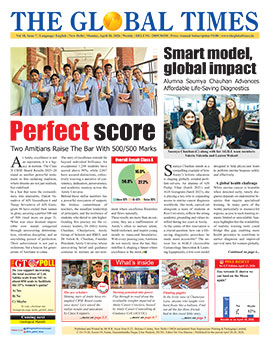
At Amity, excellence is not an aspiration, it is a legacy in motion. The Class X CBSE Board Results 2025–26 stand as another powerful testament to this enduring tradition, where dreams are not just realised, but redefined.
In a feat that turns the extraordinary into attainable, Daksh Vasudeva of AIS Vasundhara 6 and Tanay Srivastava of AIS Gurugram 46 have etched their names in glory, securing a perfect 500 out of 500 (read more on page 3). What was once deemed impossible now stands conquered through unwavering determination, relentless discipline, and an unyielding pursuit of perfection. Their achievement is not just a milestone, but a beacon for generations of Amitians to come.
The story of excellence extends far beyond individual brilliance. An exceptional 1,288 students have scored above 90%, while 2,067 have secured distinctions, collectively weaving a narrative of consistency, dedication, perseverance, and academic mastery across the Amity Universe.
Behind these stellar numbers lies a powerful ecosystem of support, the tireless commitment of teachers, the steadfast leadership of principals, and the resilience of students who dared to aim higher. Guiding this journey are the visionary leaders, Dr (Mrs) Amita Chauhan, Chairperson, Amity Group of Schools and RBEF, and Dr Ashok K. Chauhan, Founder President, Amity Universe, whose unwavering belief and guidance continue to nurture an environment where excellence flourishes and flows naturally.
These results are more than an outcome; they are a reaffirmation of Amity’s ethos to nurture talent, build resilience, and inspire young minds to transcend boundaries. With every passing year, Amitians do not merely raise the bar, they redefine it, shaping a future where excellence is the norm.
Smart model, global impact
Alumna Saumya Chauhan Advances Affordable Life-Saving Diagnostics
Saumya Chauhan stands as a compelling example of how Amity’s holistic education is shaping globally minded problem-solvers. An alumna of AIS Pushp Vihar (batch 2021) and AGS Gurugram (batch 2023), she is playing a key role in expanding access to uterine cancer diagnosis worldwide. Her work, carried out alongside a team of students at Rice University, reflects the strong academic grounding and values instilled during her years at Amity.
At the centre of this innovation is a crucial question: how can a life-saving diagnostic procedure be made more accessible? The answer lies in AGILE (Accessible Gynaecology Innovation & Learning Equipment), a low-cost model designed to help physicians learn to perform uterine biopsies safely and effectively.
A global health challenge
While uterine cancer is treatable when detected early, timely diagnosis depends on endometrial biopsies that require specialised training. In many parts of the world, particularly in resource-hit regions, access to such training remains limited or unavailable. Saumya highlights that the availability of realistic training tools could bridge this gap, enabling more health providers to contribute to earlier diagnosis and improved survival rates for women globally.
Backed by the best
The project is supported by Rice360 Institute for Global Health Technologies and was developed at the university’s Oshman Engineering Design Kitchen. Saumya worked alongside Lauren Walcott and Valerie Valentin, under the mentorship of Meaghan Bond and Jenny Carns Plante. Clinical guidance was provided by Mila Salcedo and Parisa Fallah, obstetrician-gynecologists at The University of Texas MD Anderson Cancer Center. The project was featured at the university’s annual Harrell and Carolyn Huff OEDK Engineering Design Showcase, where it won the award for ‘Best Interdisciplinary Engineering Design Team’.
Rice360 had earlier developed LUCIA, a widely used training model for cervical cancer biopsies. Building on this foundation, the team spent the past year designing a uterine model that integrates with the existing LUCIA platform. Using a Pipelle, a small, syringe-like device commonly used in clinical practice, trainees can simulate the biopsy procedure by inserting the instrument through a model vaginal canal and cervix to collect a sample from the uterus.
Engineering the essential
For a realistic tissue sample, the team experimented with a wide range of everyday materials, including soap mixtures, floral foam, and even strawberry jam, before arriving at an effective solution: a combination of hair gel and chia seeds that mimics the texture of actual biopsy tissue.
Saumya explains that this tactile feedback is critical, as physicians rely on both the look and feel of the sample to confirm success. The silicone uterus, developed using student-designed 3D-printed moulds, required extensive engineering at the first place.
Simple and effective
An early prototype of the model was tested last summer in Nairobi, Kenya, and Santo Domingo, Dominican Republic, where it got overwhelmingly positive feedback. However, testing also revealed challenges such as mold formation in humid climates, prompting the team to develop multiple formulations, including a seed-free variant. With hair gel being widely available, the solution remains practical. The team plans to conduct further field testing internationally, while also preparing the work for publication and exploring opportunities for scalable production.
A bright future
The accomplishment reflects the kind of globally aware, socially responsible innovation that Amity strives to cultivate. By encouraging critical thinking and interdisciplinary exploration, the institution continues to empower students to address pressing global challenges. Reflecting on her remarkable journey, Saumya notes that Amity introduced her to the world of innovation, a perspective that this project has further strengthened as she continues to grow as a health sciences student.